You've drafted a question that seems perfectly clear: “How helpful and easy to use was our new booking system?” Then someone asks what a person should select if the system was helpful but difficult to use.
It's a small wording problem with a practical consequence. You could receive an answer without knowing which part it describes. Better questions make it easier for people to tell you something you can use. You don't need elaborate language; you need a clear invitation to describe their experience.
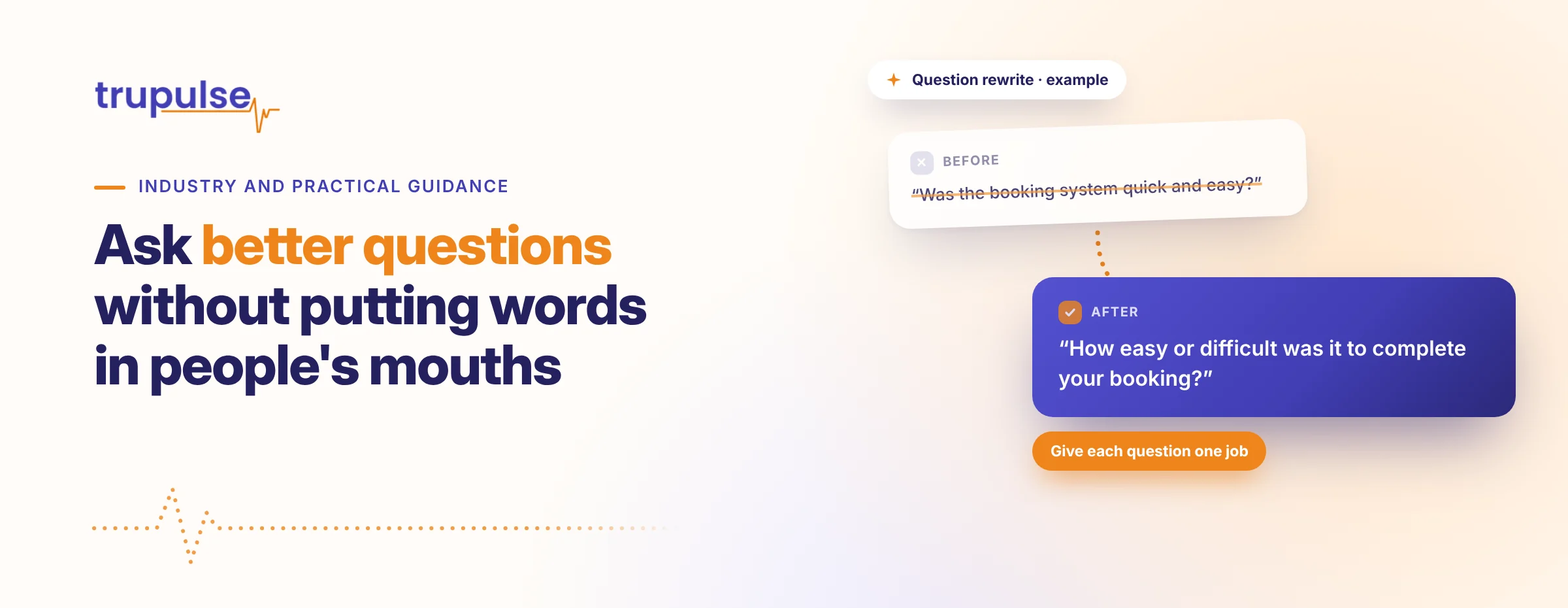
Give each question one job
Start by deciding what you want to learn from the answer. Is it about finding the service, completing a task, getting help, or understanding what happens next? Those are different experiences, even if they belong to the same journey.
Pew Research Center's question-writing guidance explains how wording and answer choices can affect responses. A useful editing habit is to look for the answer your question quietly expects, then remove that expectation.
Here are six original rewrites using a hypothetical booking service. Each makes a different problem easier to spot.
“Was the booking system quick and easy?” becomes “How easy or difficult was it to complete your booking?” Ask about time separately if that matters. One answer can now describe one thing.
“What did you like about our improved booking page?” becomes “What stood out to you about the booking page?” The revision leaves room for positive, negative, or mixed reactions without asking participants to agree that it improved.
“How frustrating was it to find an appointment?” becomes “Tell me about finding an appointment.” In a survey, you could instead ask how easy or difficult it was, using balanced options. Either approach leaves the experience open.
“Do you frequently struggle with booking?” becomes “Thinking about your most recent booking attempt, what happened?” A particular event gives a discussion something concrete to explore. If frequency matters, ask separately about a defined period.
“Don't you think reminders would solve that?” becomes “What, if anything, would have helped at that point?” You're inviting an idea rather than recruiting support for one you've already chosen.
“Which booking feature did you use?” with only online options becomes “How did you try to make your booking?” Include the relevant routes, such as telephone or in person, and an appropriate way to say none applies. People shouldn't have to select an experience they didn't have.
Ask the next question for a reason
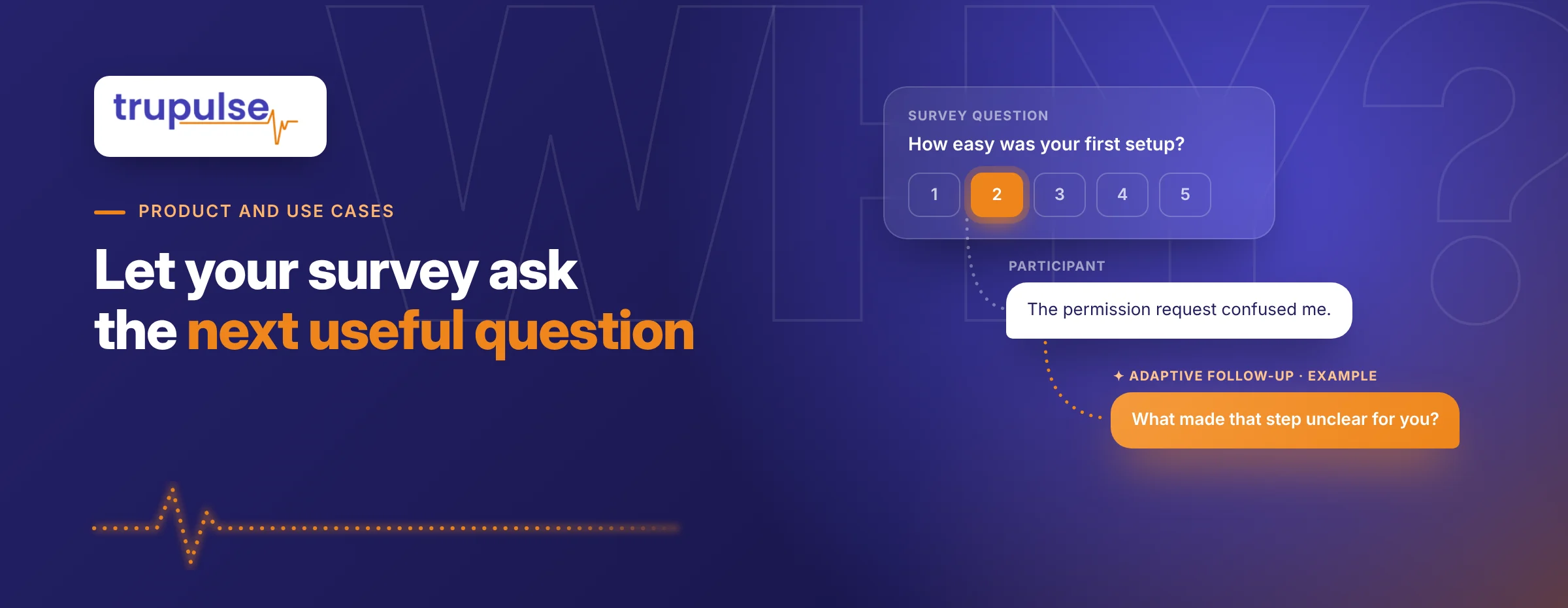
A useful follow-up grows out of the answer. If someone says booking was confusing, you might ask, “What were you trying to do when it became unclear?” That explores the point of difficulty without supplying a cause.
Different follow-ups serve different purposes. “What influenced that choice?” explores a driver. “Can you walk me through an example?” brings an experience into focus. “What would have helped?” looks for improvement ideas. Choose the purpose that serves your research question rather than asking every possible probe. A participant's suggestion can be valuable without becoming the final design. If someone asks for a reminder, you can explore what they needed to remember and when. That may open up more than one possible response.
Make the answer options work as hard as the question
Read the whole item, including the choices. Can someone express a negative experience as easily as a positive one? Are the options understandable? Is there a suitable route for someone who hasn't used the service or can't remember?
For a rating question, label the scale clearly and keep its direction consistent. For a discussion, keep the starting question open enough to invite an account, then use follow-ups for detail. A long list of examples in the opening question can accidentally do the participant's thinking for them.
Try the questions with someone who resembles your intended audience. Ask what each question meant to them and how they chose an answer. This checks comprehension; it doesn't turn a homemade questionnaire into a validated measure.
Make one useful edit today
With TruPulse, the creation agent can draft survey base questions and answer options from your goals and Q&A. You can edit them and request alternatives. For follow-ups, Fixed and Conditional questions are approved in advance; Adaptive questions are generated during participation and aren't seen or approved beforehand.
Whichever tool you use, pick one draft question and remove an assumption, split a double question, or improve an answer option. Then read it as someone whose experience differs from yours. Could they still give an honest answer? That's a useful question to keep asking.