Your team wants to understand why a service isn't being used. Someone suggests a survey. Someone else wants to talk to customers. A third person proposes bringing a group together. All three ideas sound reasonable, and the meeting starts turning into a debate about formats.
A more useful starting point is the gap in your understanding. Do you need people to answer a consistent set of questions, describe what happened to them, or explore ideas together? Once you know that, choosing a method becomes much easier. You can give the research a clear job instead of asking one format to do everything.
Match the method to the missing answer
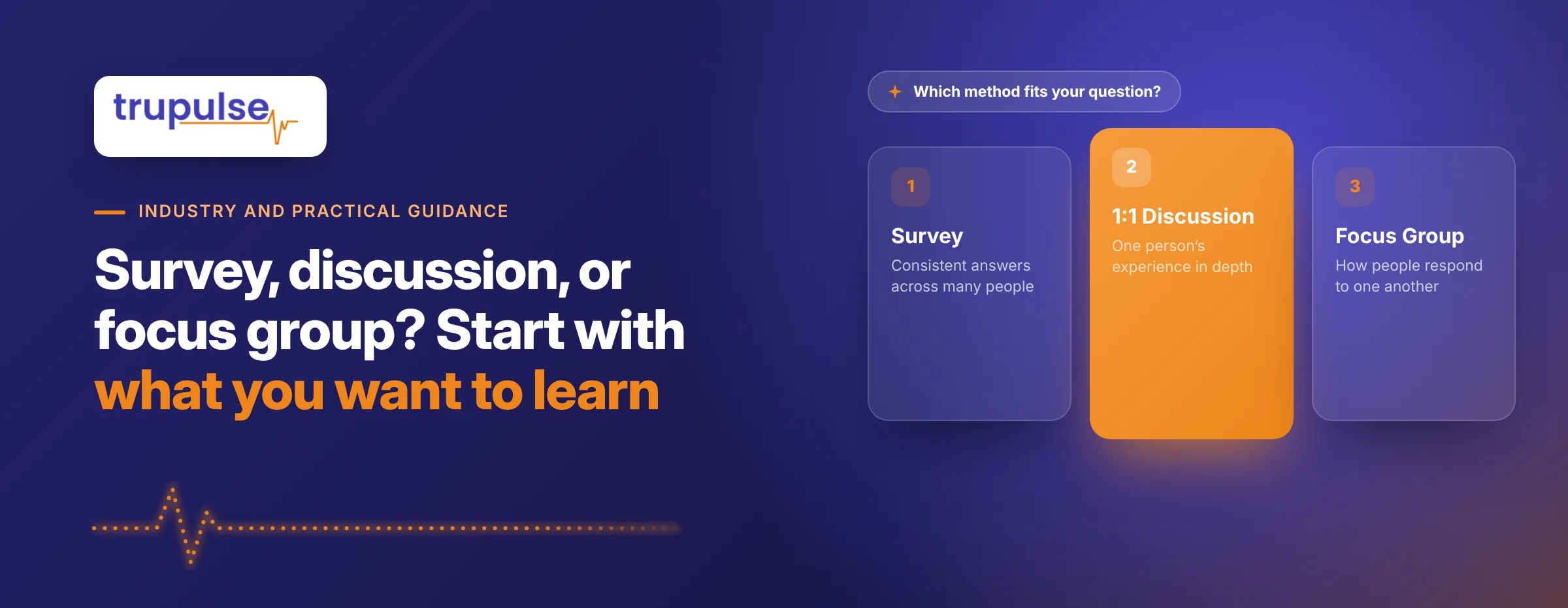
Imagine a membership organization considering changes to its professional-development program. Attendance has fallen, but the team doesn't know whether the issue is timing, content, awareness, or something else. Here are three different questions it could ask, with a suitable starting point for each.
A survey fits a question such as, “Which session times work for the members who respond?” Everyone sees a consistent set of choices, making their answers easier to compare. If you want to estimate preferences across the full membership, how you select and reach participants matters as well as the questionnaire.
A 1:1 discussion fits, “What happened the last time you considered attending?” One person can explain their schedule, expectations, and decision in their own words. The GOV.UK Service Manual's interview guidance recommends exploring real stories and examples when learning about service experiences.
A focus group fits, “How do members respond to these two program ideas, and what tradeoffs emerge as they discuss them?” Participants can build on or challenge each other's thinking. The CDC describes group interaction as a distinctive source of qualitative insight. That interaction is the reason to choose the format.
Picture the conversation you need
Suppose the organization is deciding whether to offer an evening series or a weekend workshop. A survey could collect respondents' availability. But a discussion might reveal that “evenings work” depends on recordings being available afterward, or that a weekend commitment needs a clearer practical payoff.
A focus group could then explore how people weigh those choices together. A participant's question about recordings might prompt others to explain what makes a session worth attending. Different views are useful findings; the goal doesn't have to be agreement.
For a personal or sensitive experience, consider an individual setting. A focus group is not anonymous: other participants hear what is shared. Explain participation and data use accurately whichever method you select. The format should fit what people will be asked to discuss.
Combine methods when each has a clear job
You don't have to choose one method forever. A few exploratory conversations could help the membership team discover what matters before writing survey answer options. The survey could then investigate those issues among the people it reaches.
The sequence works because the second stage answers a different question. Conversations help you understand the possibilities; a well-designed survey helps you compare consistently collected answers. Neither step automatically makes the results representative of every member.
Combining methods adds little when the next decision is already straightforward. If your immediate task is finding a suitable date among a defined group of attendees, a short availability survey may be enough. Save deeper exploration for uncertainty that could change the decision.
Give your next study one clear purpose
Before choosing a format, finish this sentence: “After hearing from these people, we want to be better able to decide…” Be specific about the decision, the people whose experiences matter, and the information you lack.
Then consider the practical fit. Can the intended participants use the proposed format? Is discussion with others appropriate? Will the results answer your question, or merely produce information that's easy to collect? A simple method with a clear purpose is a strong place to begin.
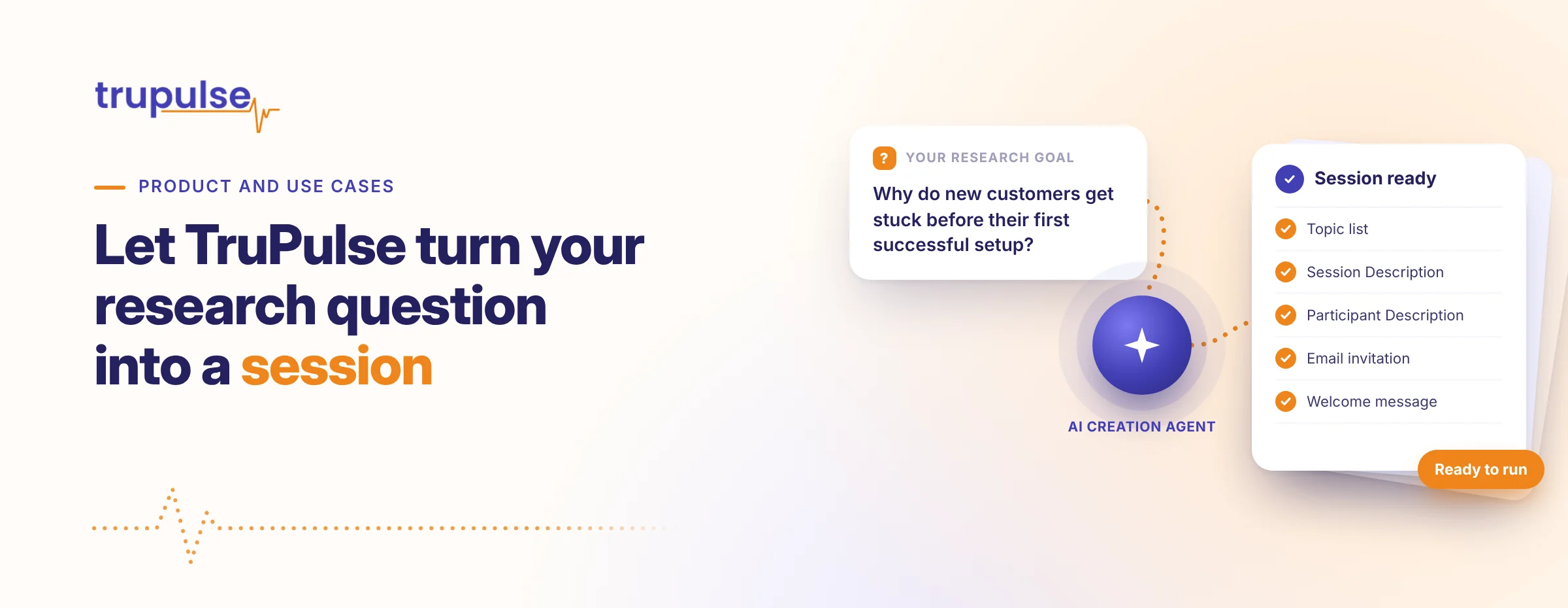
If you're using TruPulse, its creation agent can help you choose between a Survey, 1:1 Discussion, and Focus Group when you're unsure. You can then describe your goals and answer a short Q&A so the agent can prepare the session around them.
For your next planning conversation, bring one research question and ask the team to describe the answer it needs. Choose the format from there.