Two customers select the same satisfaction rating after contacting support. Your dashboard puts their responses in the same category. Your next decision may depend on how different their experiences were.
A score gives you a useful summary of a reported evaluation. It leaves the explanation open. That is a reason to pair measurement with curiosity: what happened, what mattered to the person, and what would be worth exploring next? The number can help you notice a pattern. A follow-up can help you understand what sits inside it.
A shared rating doesn't guarantee a shared experience
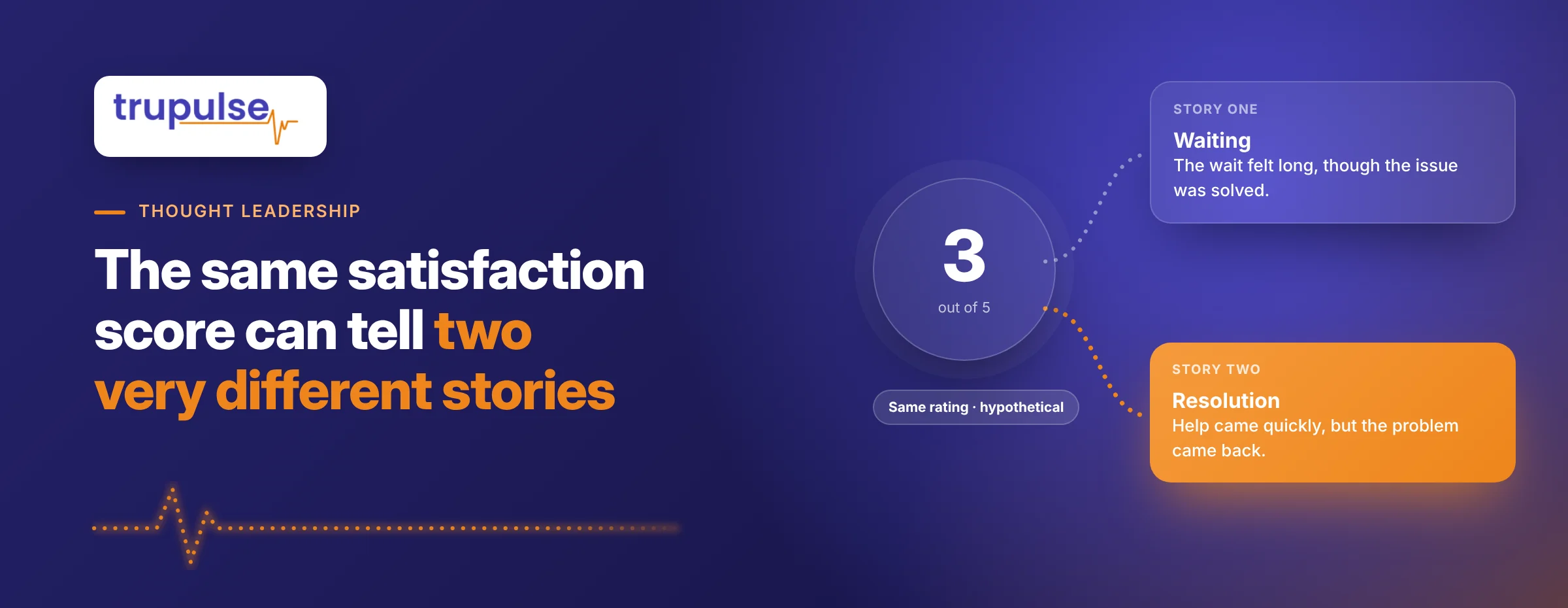
Imagine a support survey where two customers choose the middle option on a five-point satisfaction scale. One received a clear answer from a helpful adviser but waited longer than expected. The other reached someone quickly but had to repeat the issue because the first answer didn't resolve it.
The decision difference is easy to see. One raises a question about waiting and expectations. The other raises a question about resolution and continuity. A single response category can contain both.
If the team assumes the middle rating means “staff need better service training,” it may choose a response before understanding the experience. Asking what influenced the answer gives the customers a chance to identify the part that mattered to them.
Start with a neutral prompt such as, “What most influenced that rating?” Then explore the account. “What happened while you were waiting?” serves one story. “What happened after the first answer?” serves the other. Neither requires the interviewer to supply the explanation.
The question determines what the number means
A rating about speed differs from a rating about the overall support experience. The answer options and the period being considered matter too. Before interpreting a score, return to the actual question people answered.
Pew Research Center's question-writing guidance explains how wording and response choices can affect answers. A practical implication is that a familiar label such as “satisfaction” shouldn't replace the question itself when the team discusses a result.
That matters for the hypothetical customers. If the survey asks only about the adviser they spoke to, their evaluation may concern the conversation rather than the full journey. If it asks about the whole support experience, the wait or the unresolved first contact may become central.
Keep that context with the report. It makes the summary more useful to a colleague who wasn't involved in designing the study. It also keeps an interpretation from quietly becoming broader than the measure.
Scores still have a job to do
Leaders need a manageable view of the results. They can't read every account at every meeting. Consistently collected measures can help teams compare reported evaluations and decide where a closer look would be useful, when the design supports those comparisons.
That is a legitimate role. The alternative isn't to replace every number with a long collection of stories. It's to give the summary enough explanation that the next question is well chosen. A report can show the measure and then describe the different experiences associated with it.
Nor does a follow-up settle everything. A participant's explanation tells you what they describe as important; it doesn't independently prove a root cause. The support team may still need to examine service records or explore a proposed change with relevant customers.
The combination is useful because each part contributes something different. The score summarizes the response to a specific item. The explanation brings circumstances into view. Operational evidence can help the team investigate what happened around that account.
Let the explanation shape the next move
For the two hypothetical customers, the team could explore how waiting expectations are set and how unresolved requests are carried forward. Those are distinct questions, even though the ratings matched. Preserving the difference makes the report more informative.
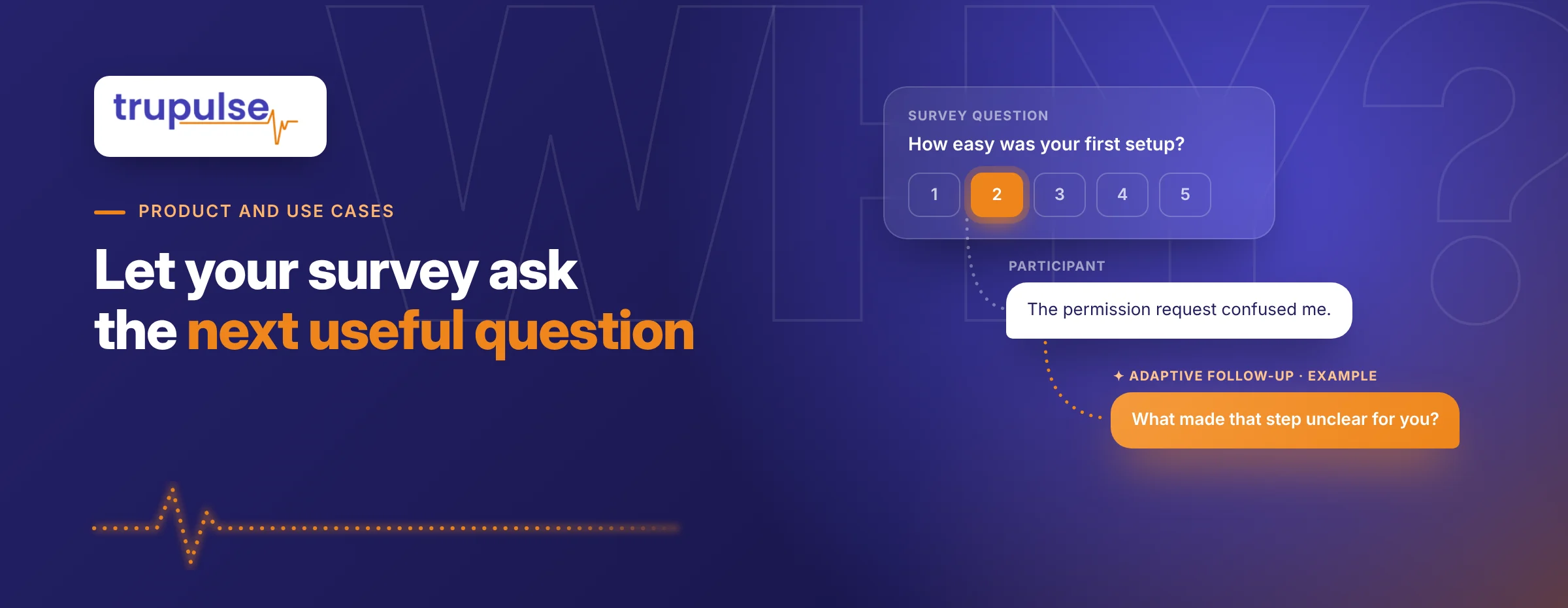
TruPulse surveys offer Fixed, Conditional, and Adaptive follow-ups to explore the answer behind a base question. Creators can select an intent, such as understanding influences, gathering examples, or surfacing improvement suggestions. That gives the follow-up a learning purpose beyond collecting another comment.
The opportunity is to hear the explanation while the participant is already reflecting on the experience. Your team can then consider what it suggests, rather than treating the score as a complete diagnosis.
Take one headline measure into your next review and ask, “What different experiences could reasonably sit behind this result?” Choose a follow-up that would help you tell them apart. That is where the score can become the start of a more useful conversation.