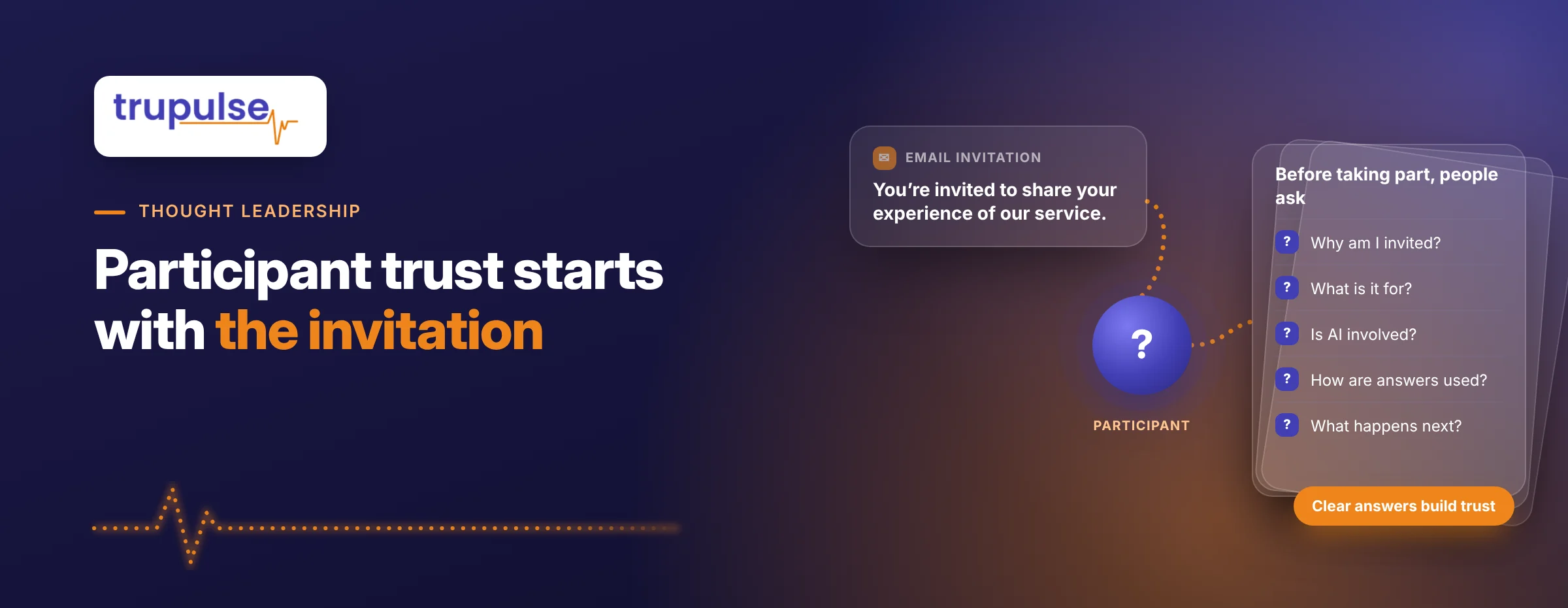
An employee receives an invitation to talk about a new way of working. The message says the organization wants honest feedback, but it doesn't explain whether AI will conduct the conversation or who will see the responses.
The research team may have thought carefully about both. The participant still has to decide what to do without that information. Trust deserves a place in the design of the study, beginning with an invitation that makes the experience understandable. Warm language helps when it accompanies clear, truthful answers to the questions a person reasonably has.
People need to know what they're joining
Imagine a team exploring how employees experience a new handoff between departments. Before someone chooses to take part, they should be able to understand who is asking, what the organization hopes to learn, and what participation involves.
If AI leads the discussion, say so plainly. Explain the expected duration using a supported estimate for that session. Describe the actual arrangements for access to responses, use of quotations, and retention. Give a suitable contact or support route when one is available.
The GOV.UK guidance on informed consent emphasizes explaining the research purpose, what happens during participation, and how information will be used. Those are useful design questions, even though each organization needs arrangements appropriate to its own context.
The invitation is part of the experience the organization is asking someone to evaluate. If the message leaves a person uncertain about who is listening, a beautifully written discussion guide doesn't resolve that uncertainty.
Specific explanations are more useful than broad reassurance
“Your feedback is important” tells someone that the organization values the exercise. It doesn't tell them what happens to their words. “Confidential” can also leave practical questions unanswered unless the scope of access is explained.
For the hypothetical handoff study, useful wording would identify the requesting team, explain that an AI interviewer will ask about recent work experiences, and describe who can access which outputs. The actual details should come from the study's arrangements, rather than a standard promise pasted into every invitation.
The format makes a difference. A focus group isn't anonymous: other participants hear what is shared. A person discussing a process alongside colleagues is making a different choice from someone answering in an individual setting. Let the explanation reflect that difference.
Clarity also includes choice. Describe whether participation is voluntary and what options exist to skip questions, stop, or seek help under the actual setup. If there are limits, people should understand them before they begin. A respectful invitation gives someone information they can use.
Keep it clear enough to read
A long disclosure can make a simple invitation feel burdensome. That is a real communication problem. The answer is to organize the information around the participant's decision and make further detail easy to find.
An opening can explain who is asking and why. A short description can cover the AI-led experience and expected commitment. Clear participation and information-use details can follow in a readable place before someone agrees. The exact format can vary, but essential facts shouldn't be hidden behind comforting language.
There is room for warmth within that structure. Explain the practical question the team hopes to understand and why this person's experience may be relevant. Use ordinary words. Give a next action that describes where the person will go, such as viewing session details, if that is what the link actually does.
Good communication makes fewer demands on interpretation. People can decide whether the experience fits what they are willing to share, rather than having to infer the rules from the tone of the message.
Carry the invitation into the rest of the experience
The same explanation should hold when the participant arrives, interacts with the interviewer or moderator, and sees any follow-up communication. If the study changes, consider what participants need to know before continuing. Consistency is part of standing behind the invitation.
A clear explanation doesn't guarantee participation or candor. Someone may understand the arrangements and still choose not to take part. Respecting that choice belongs alongside wanting to hear their experience.
For sponsors, this shifts the design question from “Does the message sound reassuring?” to “Can someone understand what we're asking and what will happen?” That is a more concrete responsibility and a better basis for reviewing the experience.
Read your next invitation as someone receiving it without any background conversation. Could they explain who is asking, how AI is involved, and what happens to their responses? Make the answers easy to find before asking them to share.